Searching for BLS CPR certification in Redwood City usually means one of two things: an employer just told you it’s required, or you’re trying to figure out whether it’s the right training for your situation in the first place. BLS, short for Basic Life Support, is a provider-level certification built around team-based CPR response, AED use, and recognizing cardiac emergencies quickly. It’s different from a general CPR class, and knowing which one applies to you can save a wasted registration. This article breaks down what the certification actually covers, who typically needs it in the Redwood City area, and what to expect once you’re enrolled.
Quick answer: BLS certification is the CPR credential most commonly required for healthcare workers, clinical staff, and workplace safety teams, and it’s generally valid for two years before renewal is needed.
What BLS CPR Certification Actually Covers
BLS training teaches high-quality chest compressions, rescue breathing, and AED operation, along with recognizing the signs of cardiac arrest quickly enough to act. Unlike a general public CPR class, it’s built around scenarios where more than one trained responder may be present, so the course includes team-based CPR technique and rescuer-switching during compressions.
The certification also covers choking response and basic airway management for adults, children, and infants, depending on the specific course. Instructors evaluate hands-on technique directly, rather than relying solely on a written exam, since the goal is confirming that participants can actually perform the skills under time pressure.
Who Typically Needs This Certification
BLS is most often required for people working in or around clinical environments. That includes nurses, medical assistants, physical therapists, and administrative staff at facilities like Sequoia Hospital in Redwood City, along with employees at smaller clinics and outpatient offices throughout San Mateo County.
Outside of healthcare, some workplace safety teams and designated emergency responders at larger employers also pursue BLS rather than a general CPR class, particularly when an internal policy calls for provider-level training. If your job doesn’t involve direct patient care or a formal safety-response role, a standard CPR and First Aid course may be sufficient, but confirming with your employer or licensing board is the only reliable way to know for certain.
How BLS Differs From a General CPR Class
The two are related but not interchangeable. A general CPR and First Aid class teaches the same core skills, compressions, rescue breathing, and AED use, but at a pace built for the general public rather than clinical or team-response settings.
BLS goes further by incorporating two-rescuer CPR scenarios, more structured skills testing, and content aligned with recognized resuscitation guidelines used in healthcare settings. If a job posting, licensing requirement, or clinical rotation specifically lists “BLS” or “BLS Provider,” that’s asking for this version rather than the general public course, even though both use similar underlying techniques.
What to Expect Once You’re in Class
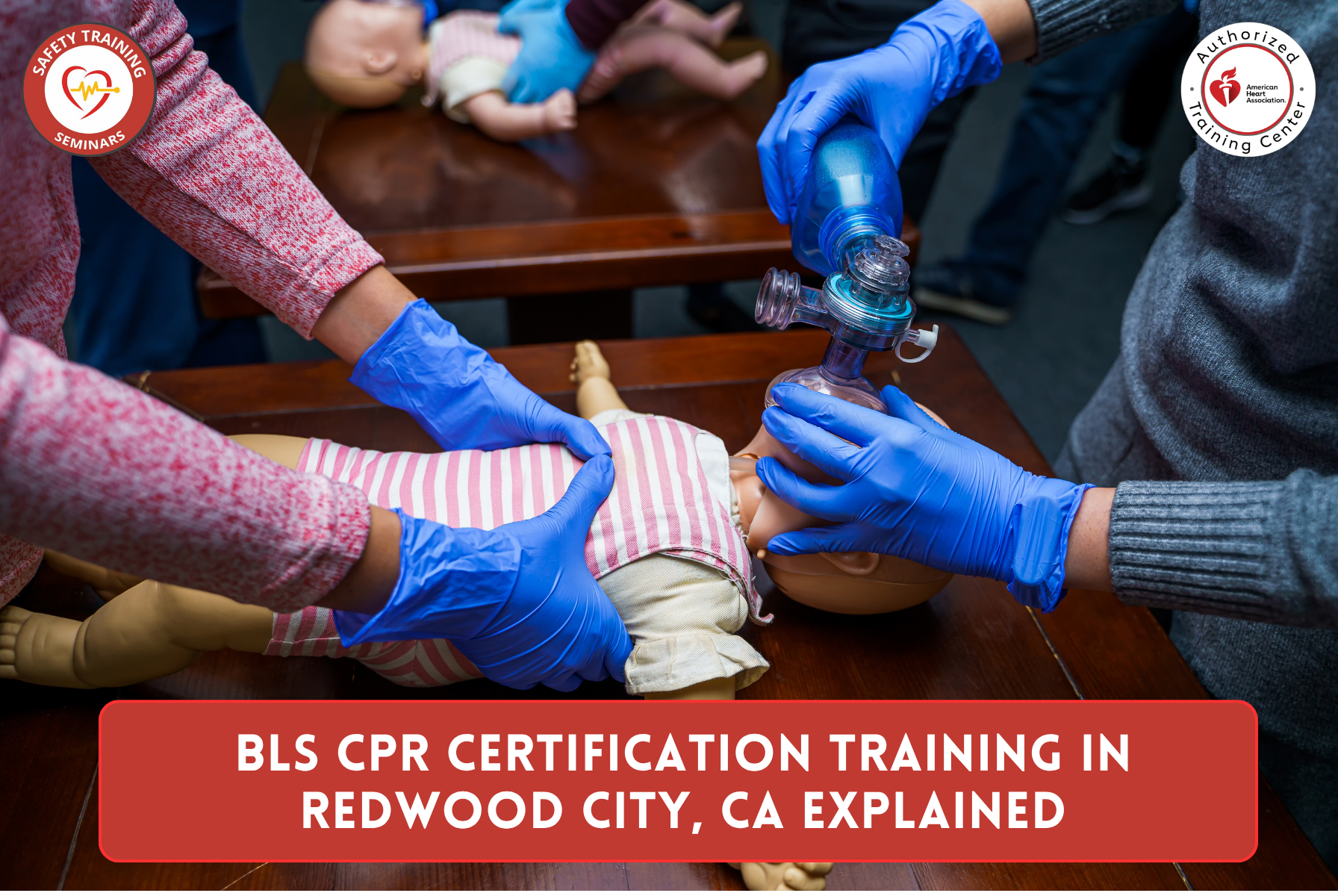
A typical BLS session moves through a short review of core content, followed by hands-on skills practice on training manikins. Expect to work through compressions individually first, then in a paired or team scenario that mirrors how a real response would likely unfold with more than one person present.
AED training is usually included as well, using a training unit so participants can practice pad placement and follow the device’s prompts without pressure. Most courses close with a skills check where an instructor observes technique directly, along with a knowledge assessment that may be written or completed online ahead of time.
In-Person, Online, and Blended Formats
Blended courses have become common because they let you complete the lecture and knowledge portion online, then attend a shorter in-person session for the hands-on skills check. This tends to work well for people balancing shift schedules or commuting from elsewhere on the Peninsula.
A fully online certificate without any in-person skills verification is generally not accepted as valid BLS certification, since hands-on competency can’t be confirmed remotely. If your employer specifically requires BLS, it’s worth confirming ahead of time whether they’ll accept a blended format or expect a fully in-person course.
How Long Certification Lasts
BLS certification is generally valid for two years from the date of course completion, after which renewal is required to stay current with updated resuscitation guidelines. Many employers ask staff to renew 30 to 60 days before the expiration date to avoid a lapse that could affect scheduling or credentialing.
If your certification has already expired, some training providers require the full initial course rather than a shorter renewal session, since specific policies vary by provider. Checking directly with whoever issued your original card is the most reliable way to confirm your options before registering.
Training Access Across the Peninsula
Redwood City sits in a part of San Mateo County with a fairly wide mix of employers, from healthcare facilities like Sequoia Hospital to office-based tech and professional-services companies, which means BLS demand here comes from more than one direction. Some readers are healthcare staff renewing a required credential, while others are workplace safety leads completing a company-wide training initiative.
Because commute patterns along the Peninsula rarely stay within one city, employees traveling from Belmont or Burlingame may prefer to check the BLS and ACLS class schedule in Belmont or the CPR and BLS certification options in Burlingame if either fits their route better than a trip into Redwood City itself.
Enrolling With Safety Training Seminars in Redwood City
Safety Training Seminars operates a Redwood City training location at 650 Broadway, Suite 4, Redwood City, CA 94063, offering BLS CPR Certification along with related First Aid and ACLS courses. This gives healthcare staff, workplace safety teams, and general students in the area a local option to review before deciding on a course date and format.
Before enrolling, confirm exactly which certification level your employer or program requires, then review the course page for current scheduling. Readers based further south on the Peninsula may also want to compare the CPR and BLS training schedule in Atherton, while those near the northern part of San Mateo County can check the BLS and First Aid course options in Colma.
Frequently Asked Questions
How do I know if I need BLS or just a general CPR class? Check your job description, licensing requirement, or employer policy first, since these usually specify the exact certification level. Healthcare and clinical roles typically require BLS specifically, while general workplace or personal preparedness needs are often met by a standard CPR and First Aid course.
Is an online-only BLS certificate accepted in Redwood City workplaces? Usually not by itself. Most employers require a hands-on skills check completed in person, since technique can’t be verified through an online module alone. A blended course that pairs online coursework with an in-person skills session is typically the accepted middle ground, but confirm this with your employer directly.
What should I bring to a BLS class? Bring a valid photo ID and, if you registered for a blended format, proof that you completed the online coursework beforehand. Comfortable clothing is recommended since the hands-on portion involves kneeling and repeated movement during skills practice.
Does BLS certification transfer between employers? Generally, yes, since BLS follows recognized national guidelines rather than being tied to a specific employer. However, some employers have their own policies about which training providers they accept, so it’s worth confirming with a new employer rather than assuming automatic acceptance.
Can I take a BLS class outside Redwood City if it fits my schedule better? Yes. Safety Training Seminars offers courses at several nearby Peninsula locations, so students commuting from Belmont, Burlingame, Atherton, or Colma can often find a class date and format that works better around their commute or shift schedule.
Deciding on Your Next Step
The most useful thing to confirm before registering is which certification level actually applies to your situation, since BLS and general CPR training serve different purposes and aren’t interchangeable for employer or licensing requirements. Once that’s settled, choosing between an in-person or blended format usually comes down to what fits your schedule.
Safety Training Seminars’ Redwood City location offers BLS CPR Certification and related courses, with additional Peninsula options for readers whose commute points toward a different city. Review the course page that matches your needs to check current format and availability before enrolling.